Not All Video Platforms Are Equal. Here's How Cinemata Compares
By the Cinemata Development Team
This comparison was originally put together for funders, partners, and organisations considering Cinemata as part of their work. But we think it's just as useful for filmmakers, educators, and community members who want to understand what Cinemata actually is — and what makes it different from the platforms most people default to.
When a filmmaker in Southeast Asia finishes a film about land rights, water defenders, or state violence, they face an immediate question: where does it live? The obvious answers — YouTube, Vimeo, Facebook all come with conditions. Algorithmic obscurity. Content moderation systems that weren't designed with activists in mind. Advertising ecosystems that sit uncomfortably alongside human rights subject matter. Terms of service written for a very different kind of creator.
Cinemata was built for a different answer. Free to upload, free to watch, no ads, no surveillance, open source, governed by the communities it serves. The slides below break down how it compares to the platforms that were never quite built for this work.
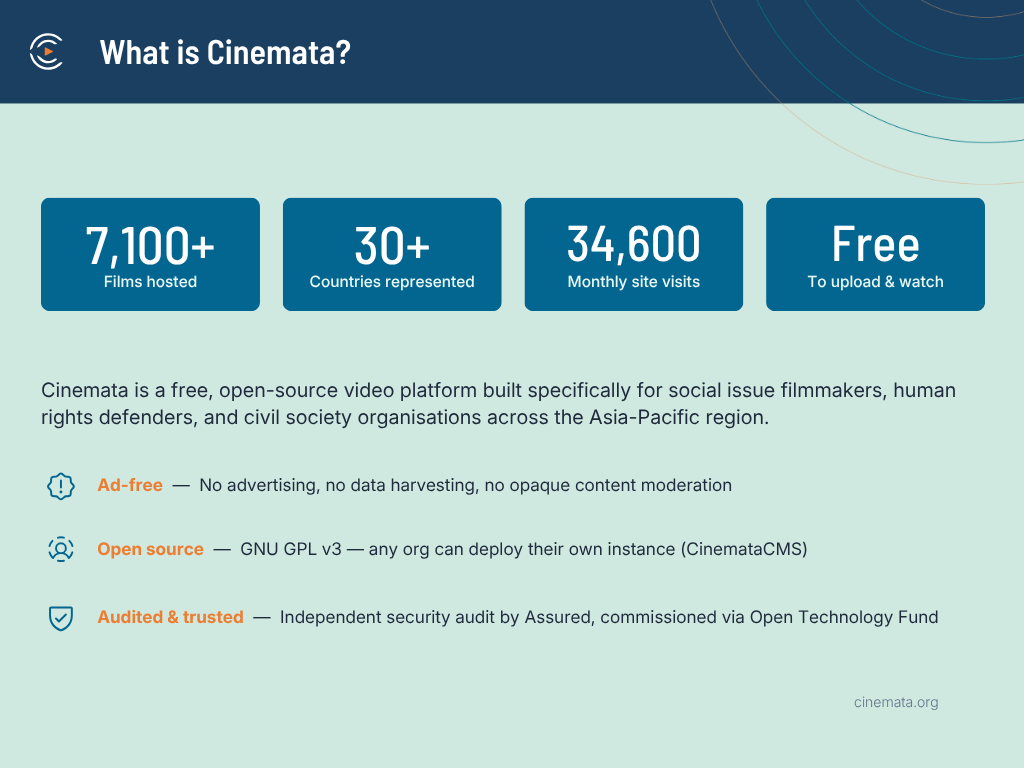
One number worth pausing on: Cinemata averages over 34,600 visits a month. During the Rising Waters, Raising Rights human rights film programme in December 2025, with parallel screenings in the Philippines, Malaysia, Thailand, and New York, that figure reached 53,300. That kind of traffic doesn't come from algorithmic promotion. It comes from communities that sought out the films because they mattered.
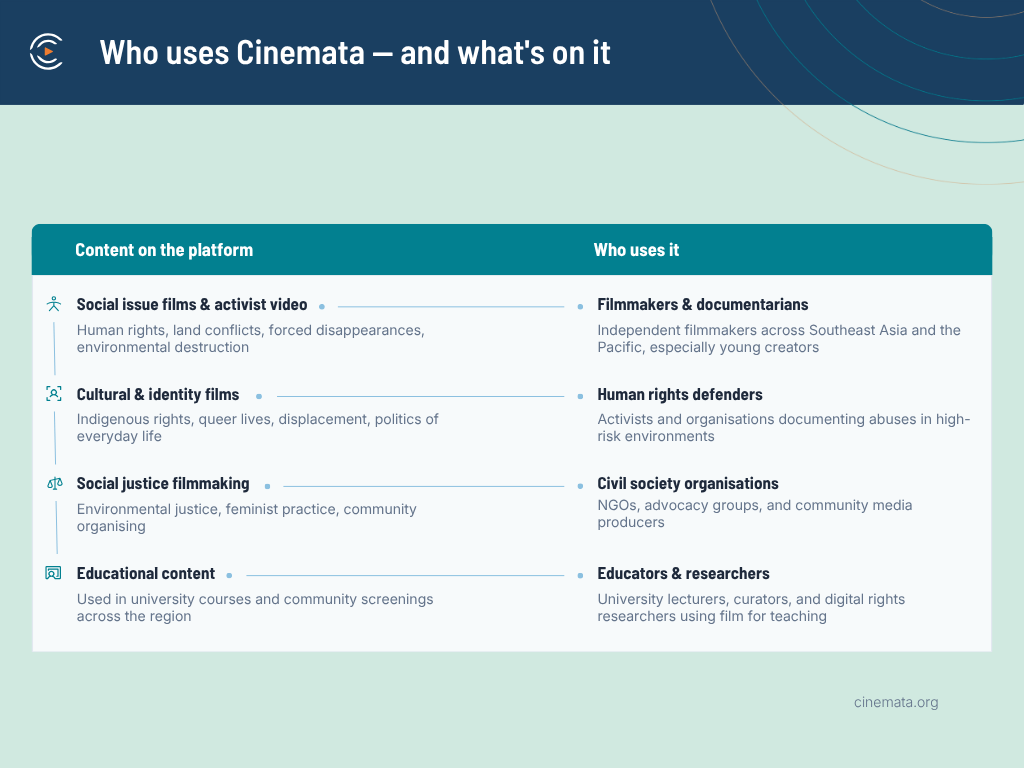
The platform hosts over 7,100 films from 30+ countries, but the numbers only tell part of it. What distinguishes Cinemata isn't just the volume, it's the specificity. Films about forced disappearances, land conflicts, indigenous rights, and queer lives under authoritarian governments. Content that has been taken down elsewhere, or that was never welcome on mainstream platforms to begin with. The people who use it, like filmmakers, human rights defenders, educators, civil society organisations, chose it for exactly that reason.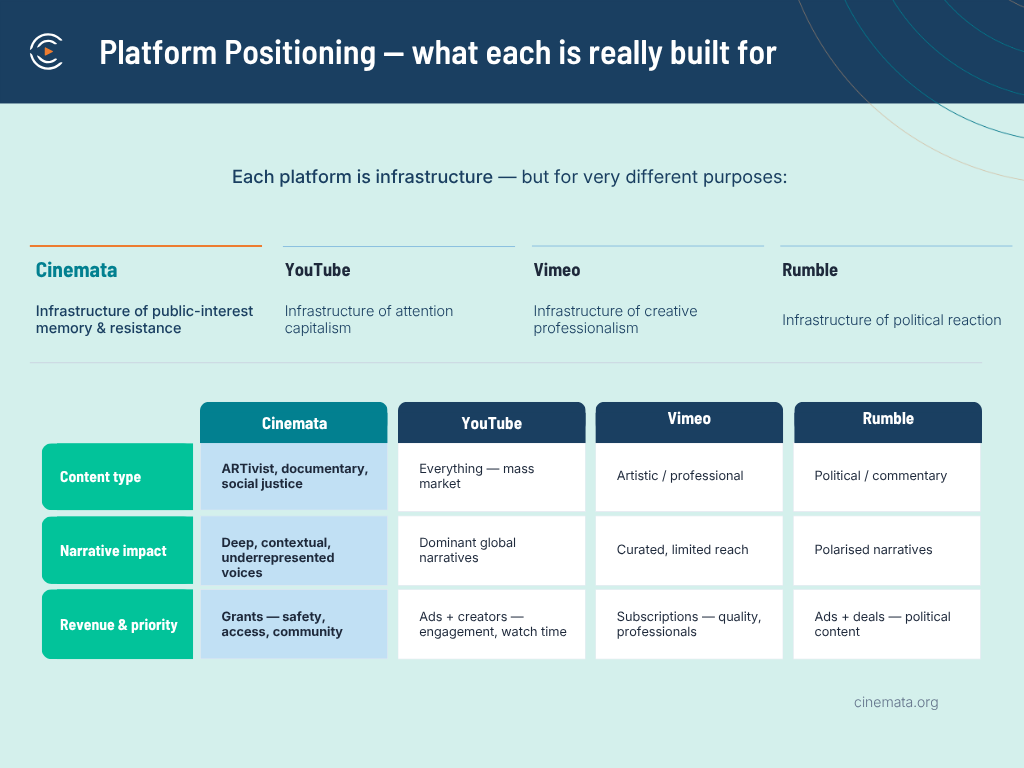
Each of these platforms is infrastructure. But infrastructure reflects the values and incentives of whoever built it. YouTube is built to maximise watch time and ad revenue. Vimeo is built for creative professionals willing to pay for quality hosting. Rumble is built around political commentary with minimal content moderation. Cinemata is built around something different: public-interest memory and the needs of people documenting what power would rather remain undocumented.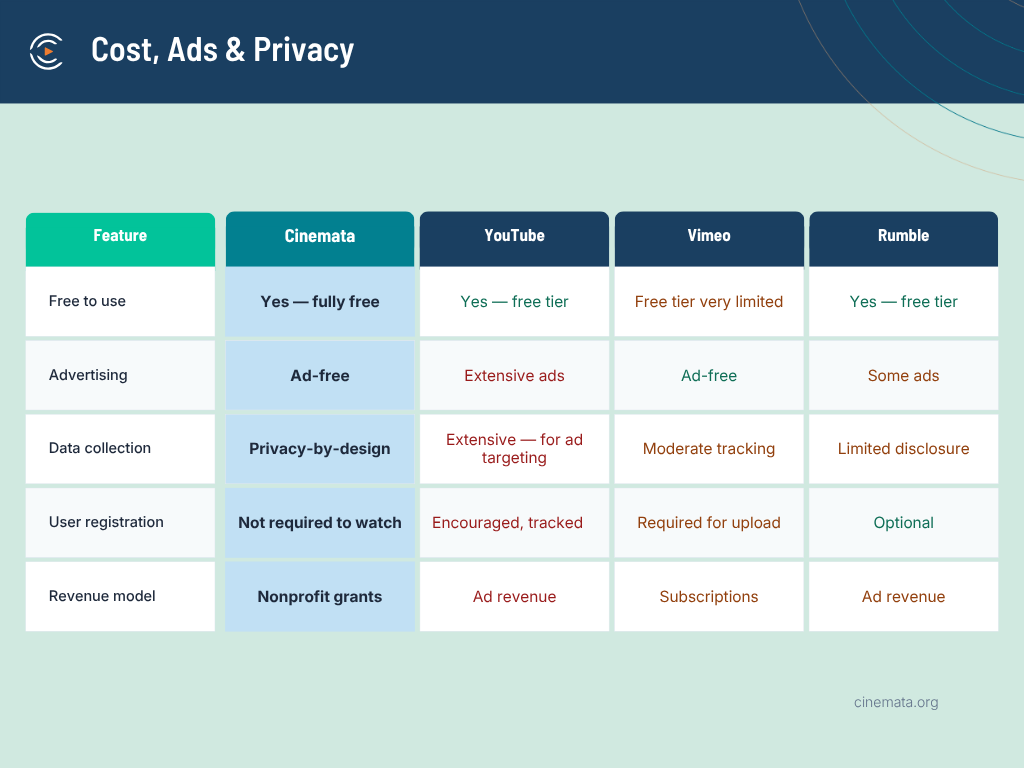
The difference in privacy is worth naming directly. YouTube tracks watch history, location, device, and behaviour, and that data feeds its ad targeting. For a human rights defender in a high-risk environment, that's not a minor inconvenience. Cinemata collects nothing for that purpose. No registration required to watch, no behavioural profile being built. That's a design choice, not a feature gap.
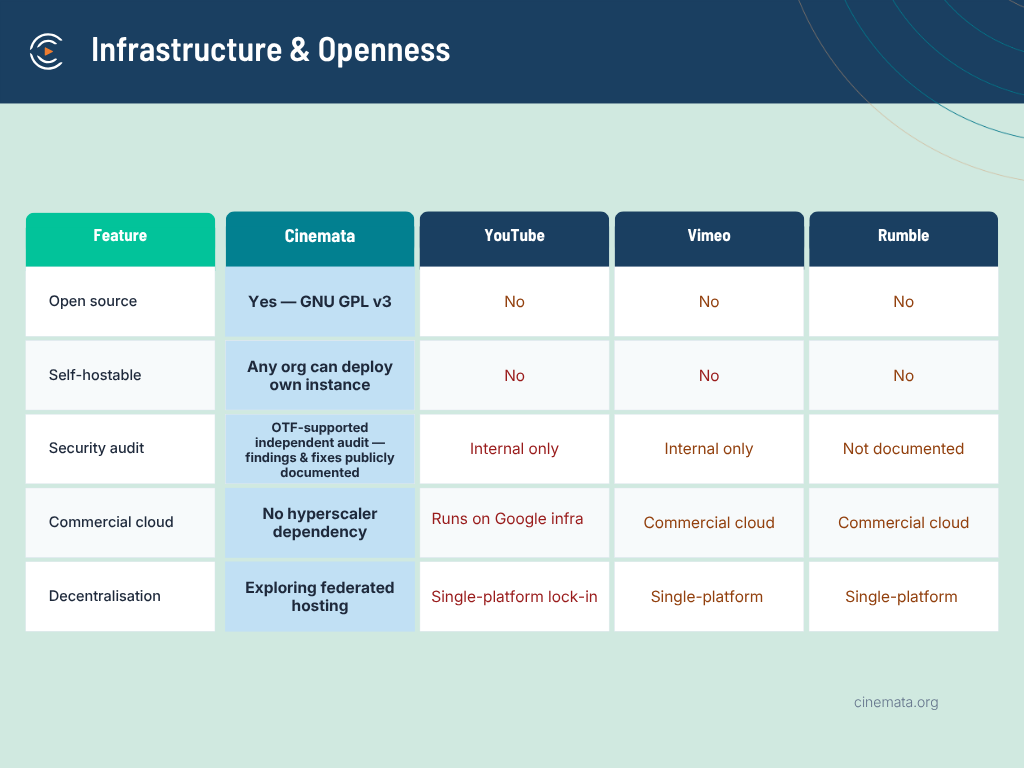
Being open-source under the GNU GPL v3 means something specific: any organisation can take CinemataCMS — the software that powers Cinemata — and deploy their own instance. No permission needed, no licensing fees, no platform dependency. The security audit, commissioned through the Open Technology Fund and carried out by Assured, is publicly documented. That's a level of transparency the other platforms here don't offer. For civil society organisations thinking about digital sovereignty, this matters.
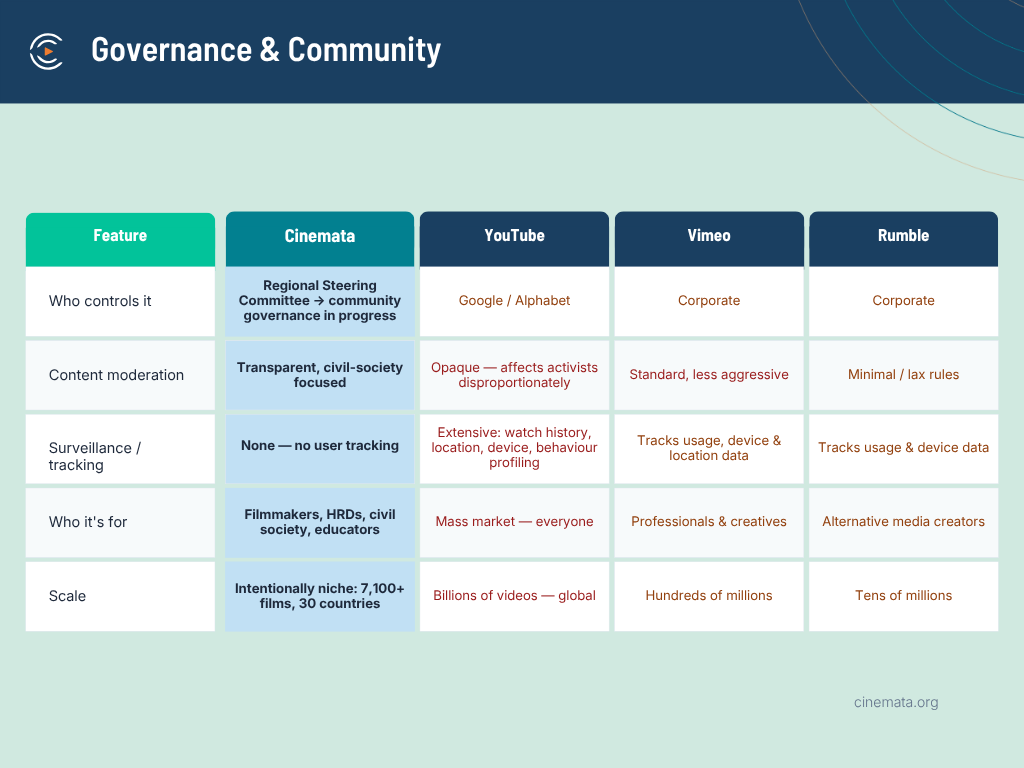
Who controls a platform determines what happens to content when things get difficult. YouTube is controlled by Google/Alphabet, with content moderation decisions that have repeatedly affected activist and civil society accounts in ways that were neither transparent nor easy to appeal. Cinemata is moving toward community governance — a regional Steering Committee is already in place, comprising film programmers, academics, feminist practitioners, and digital rights researchers. Full community ratification is planned for mid-2026.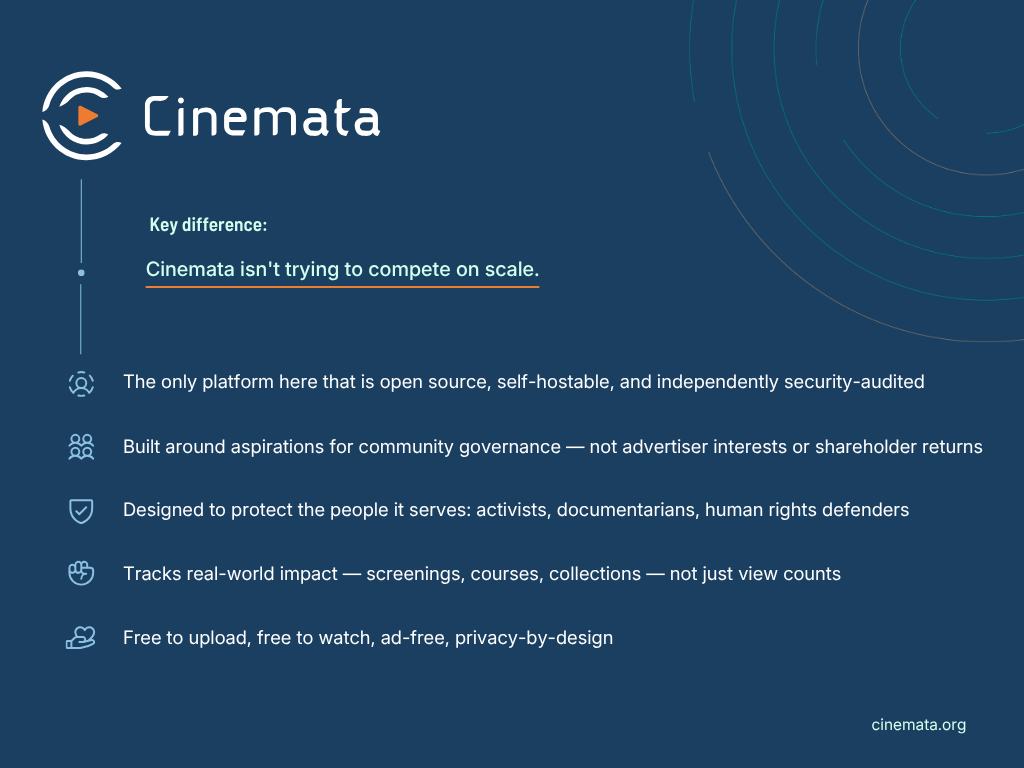
The point isn't that Cinemata is better than YouTube in every respect. It isn't trying to be. The point is that not all video infrastructure is neutral — each platform encodes a set of priorities, and those priorities have real consequences for the people using it. Cinemata's priorities are safety, access, and community. That's what it's built around, and that's what it intends to stay.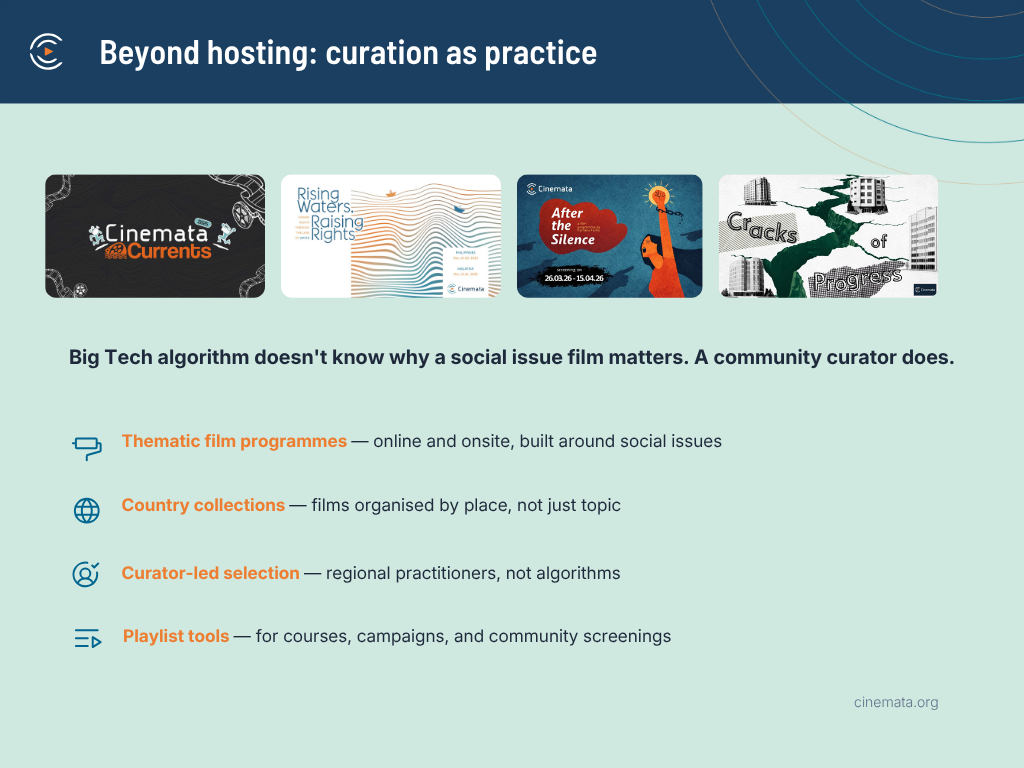
A platform that hosts films passively is useful. A platform that actively works with them is something else. Cinemata produces thematic film programmes — Rising Waters, Raising Rights, Cinemata Currents, After the Silence, Cracks of Progress — developed in collaboration with regional curators who understand the political and cultural weight of the films they select. Country collections organise content by place, making it easier for educators and researchers to find work from specific contexts where that work carries real stakes. The algorithm doesn't know why a film matters. A community curator does.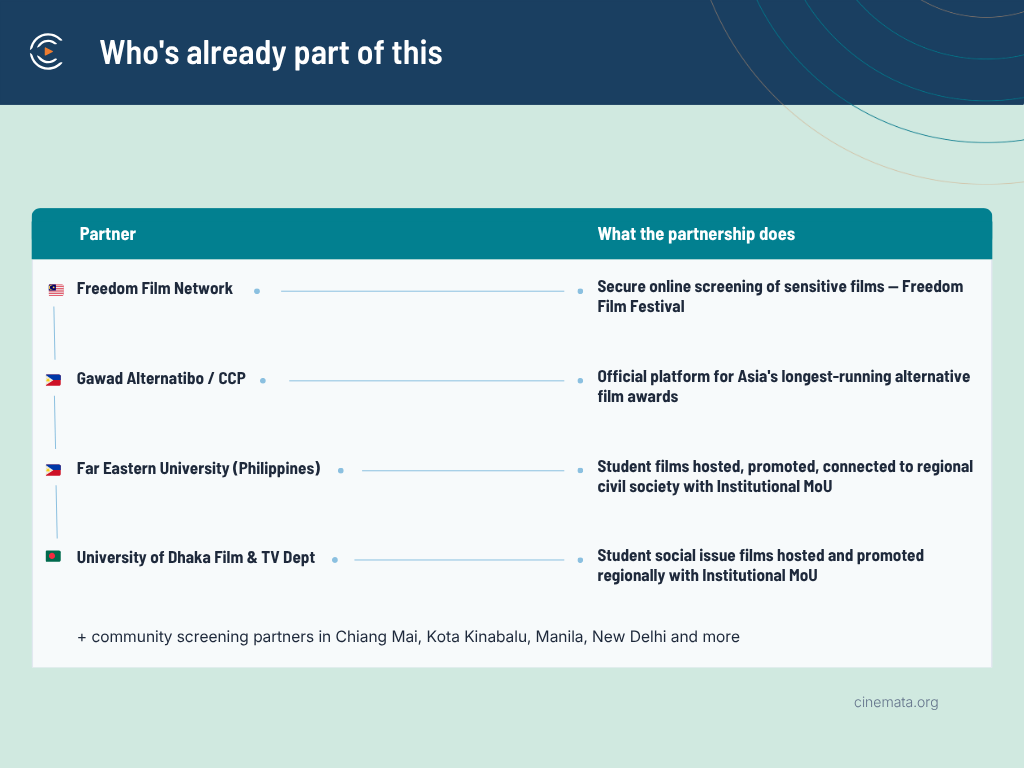
Cinemata's partnerships aren't sponsorships or content deals — they're working relationships built around shared values.
Freedom Film Network in Malaysia has used Cinemata's secure player to screen sensitive films legally online, including at the Freedom Film Festival. Gawad Alternatibo and the Cultural Centre of the Philippines made Cinemata the official home for Asia's longest-running alternative film awards. The University of Dhaka Film & TV Department and Far Eastern University in the Philippines have formal MOU partnerships that connect student filmmakers to regional civil society networks, their work would never have reached otherwise. Community screening partners in Chiang Mai, Kota Kinabalu, Manila, New Delhi, and beyond extend that reach further.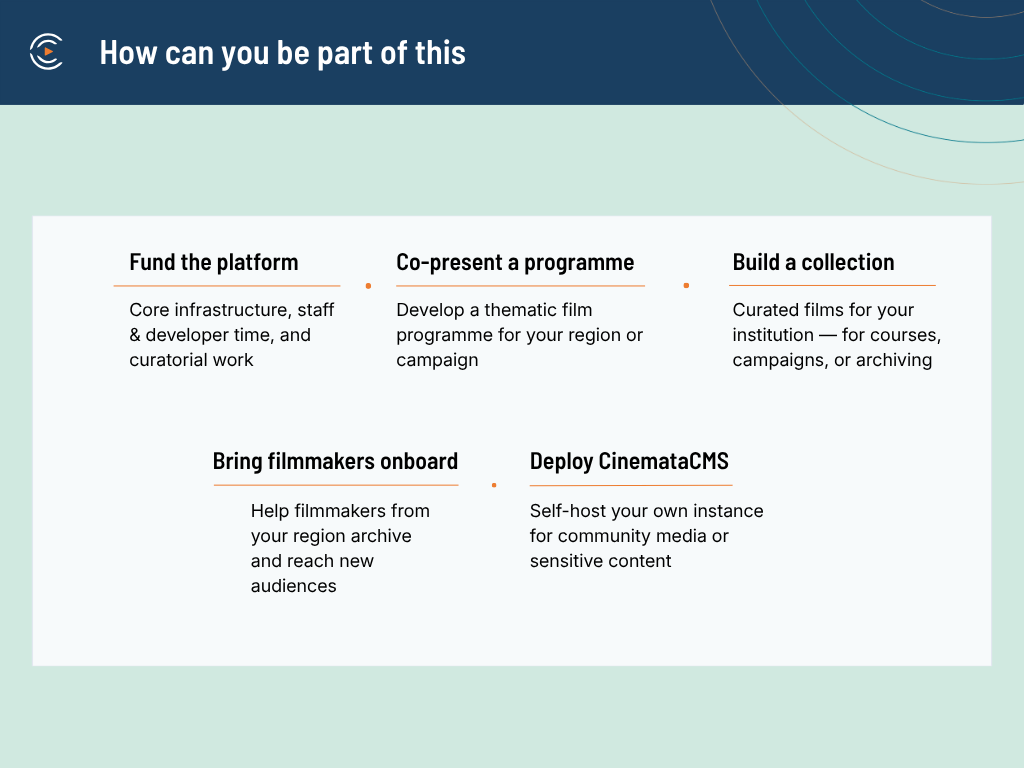
There are several ways to support Cinemata, depending on what you do:
-
- Funders can support core infrastructure, staff, and curatorial work — the things that keep the platform running and the programmes happening.
- Organisations working in specific regions or on specific issues can co-present a film programme, bringing their audience and context, while Cinemata brings the films and the platform.
- Universities, libraries, and civil society organisations can build institutional collections — curated films available for courses, campaigns, or long-term archiving.
- If you work with filmmakers directly, you can help bring them onto Cinemata, ensuring their work doesn't disappear after a festival run.
- If your organisation needs its own video infrastructure, CinemataCMS is open source and deployable — Cinemata can support initial setup for mission-aligned partners.
Cinemata is part of EngageMedia's work supporting free expression, digital rights, and community-led media across Asia and the Pacific. If you're a filmmaker looking for a home for your work, an educator building a screening programme, or an organisation interested in deploying CinemataCMS for your own community, we'd love to hear from you.
Explore the platform at cinemata.org, check out the open-source codebase on GitHub, or get in touch at [email protected].