Cinemata Convenes Its First Steering Committee
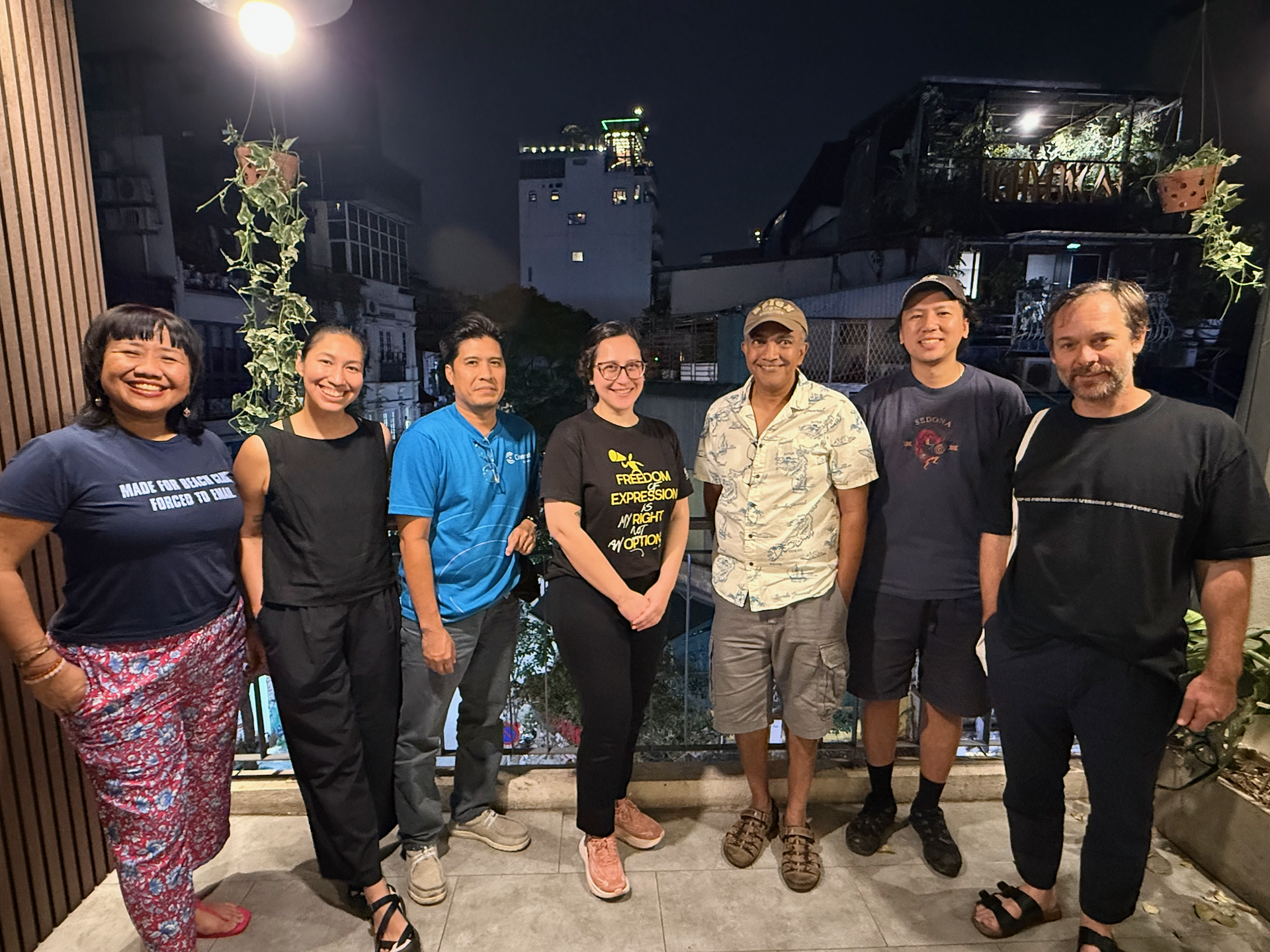 (Left to right) Meninaputri Wismurti, Jen Tarnate (Cinemata Project Lead), King Catoy (Development Lead), Alex McCarthy, Sam De Silva, Matthew Nguyen (Board Chairperson, EngageMedia), and Martin Potter. The Cinemata Steering Committee convened for the first time in Hanoi, March 26, 2026.
Cinemata is at a stage where the questions we face are bigger than any one team can answer alone. How does a community-driven platform sustain itself without becoming something else in the process? Who gets a say in where it goes, and what does shared stewardship actually mean across thirty-plus countries and a dozen languages?
This year, we began building a circle of people who can help us work through those questions.
We are pleased to announce the formation of the Cinemata Steering Committee, a voluntary advisory group of practitioners, researchers, and advocates from across the Asia-Pacific who are willing to challenge our thinking, sharpen our strategies, and help root Cinemata more deeply in the communities it serves.
Gathering in Hanoi
The Steering Committee held its first gathering in Hanoi on March 26, 2026, convening alongside EngageMedia's board meeting. The Cinemata team opened the session by sharing a full picture of where the platform stands: from curation and programming milestones across the region to the technical foundations being built under the platform's open-source codebase. From there, the conversation turned to harder work — mapping out funding pathways, identifying funder relationships worth cultivating, and stress-testing sustainability models that could carry Cinemata beyond its current phase of support. It was a productive start.
Meet the Steering Committee
The members bring complementary expertise across film programming, feminist advocacy, digital rights, and media for development, and a shared familiarity with the kinds of communities this platform exists to serve.
Martin Potter is a researcher and faculty member at Deakin University's School of Communication and Creative Arts, and a director of the Big Stories Co. A multi-award-winning creative director and producer of transmedia and media for development projects, his work has taken him from a TED City 2.0 award to Phnom Penh's White Building, with practice that consistently centres communities rarely seen in mainstream media.
Alex McCarthy is a feminist activist, writer, and co-founder of Kemban Kolektif, a consultancy collective supporting civil society organisations in Southeast Asia and globally. She currently serves as Programme Manager for Movements and Alliances at ARROW, working across gender equality, reproductive health and rights, disability justice, and climate justice. She brings deep knowledge of the advocacy ecosystems Cinemata works alongside.
Meninaputri Wismurti is an Indonesian film programmer and festival director with decades of experience at the intersection of cinema and human rights. She is the co-founder and Programme Director of 100% Manusia Film Festival in Jakarta, and Co-Director of Europe on Screen, Indonesia's longest-running foreign film festival. A founding figure of Q! Film Festival, the first queer film festival in Indonesia, she has served on juries at the Berlinale, Wicked Queer Boston, and QCinema, and has mentored festival organisers internationally through Movies That Matter: Cinema Without Borders.
Sam De Silva is the founder of CommonEdge Asia, a research and advisory organisation focused on technology, human rights, and culture in the Asia Pacific. He is the founding producer of Balance, a CommonEdge publication dedicated to challenging and reimagining digital power in the global south. He has extensive experience in media and technology initiatives and in managing small- and large-scale projects.
What guides us
The Steering Committee is not a board. Its members are not here to manage Cinemata or make operational decisions on our behalf. They are here to orient us, to bring outside perspective to inside questions — and to hold us accountable to the values that brought this platform into being.
Those values are worth stating plainly. Cinemata is committed to regionally grounded infrastructure, feminist and inclusive technology that centres care, safety, and equity, not just in what we publish, but in how the platform itself is built and governed. We believe in openness and shared ownership, in decisions made with clarity and long-term integrity, and in sustainability models that serve the community rather than the other way around. These are not aspirations. They are the conditions under which Cinemata remains worth sustaining.
The Steering Committee's role is to make sure we hold to them, especially when things get difficult.
What comes next
The work begun in Hanoi continues through the coming months, with the Steering Committee providing guidance on funder relationships, sustainability directions, and the governance questions we are working through together with the broader community.
It all builds toward the Cinemata Community Convening on June 10–11, 2026, in Metro Manila, held alongside DRAPAC26. This gathering is where the wider Cinemata community — filmmakers, developers, curators, educators, partners, and advocates from across the region — will have the opportunity to shape the platform's direction and help define what shared governance means in practice.
More details on the convening will follow. We hope to see you there.