Cinemata Features: Trần Khánh An
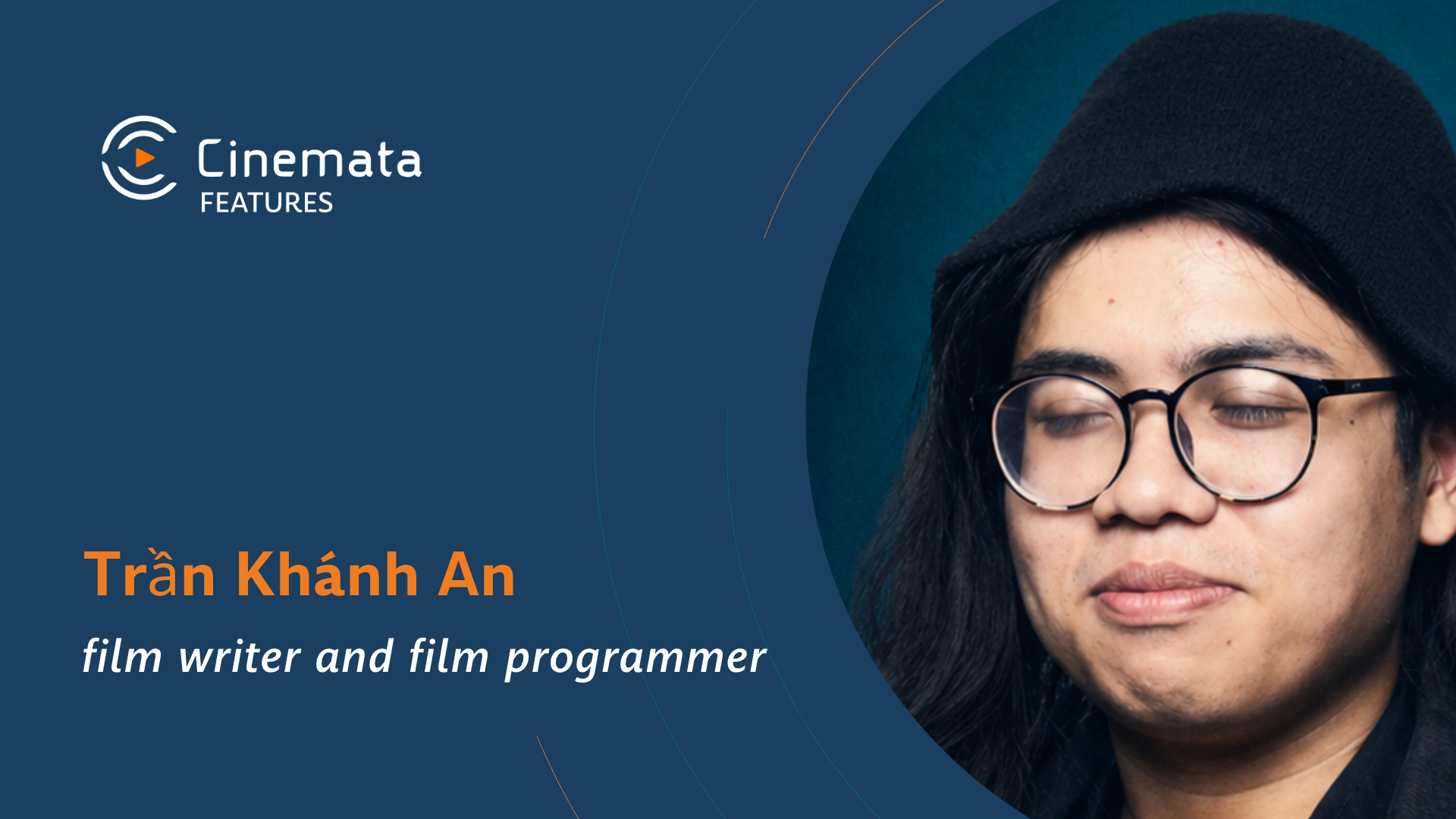
Ghosts, Fragments, and Open Endings: In Conversation with Trần Khánh An
For Vietnamese film writer and programmer Trần Khánh An, curation is not about arriving at fixed conclusions, but about holding open spaces where histories, memories, and audiences can continue to encounter one another in unfinished and evolving ways. Working at the intersection of criticism, archival research, and programming, An’s practice often traces the afterlives of images, places, and communities shaped by disappearance, marginalization, and historical rupture. His programme reflects this ongoing inquiry into how cinema can preserve traces of what risks being forgotten, while also creating new contexts through which those traces may continue to resonate.
Across our conversation, An spoke about the delicate negotiation involved in placing films together—balancing the preservation of a work’s original meanings with the possibility of producing new forms of knowledge and interpretation. Drawing from experiences within Vietnam’s independent film and archival communities, he reflects on curation not as a process of closure, but as an open-ended structure where audiences remain active participants in shaping meaning. Rather than positioning the curator as the final authority, he sees the most important space as the one between the films and the people encountering them.
The discussion also moves through questions of censorship, archival gaps, and the emotional realities of working with histories that feel incomplete, fragmented, or erased. An reflects on the quiet negotiations that shape independent film practice in Vietnam, where restrictions are often internalized as part of everyday creative life, influencing not only what can be shown, but how filmmakers and curators imagine space, memory, and possibility itself. Through references to ghost stories, campfire gatherings, and disappearing places, his programme emerges as both a curatorial and personal attempt to reach toward things that are no longer fully present, while still believing in cinema’s ability to create life beyond absence.
In this Curator Spotlight conversation, An shares insights into research, archives, accumulation, and the evolving process of building a programme from fragments, notes, and emotional resonances. At its core, his practice remains rooted in a hopeful belief that cinema can continue to reunite, sustain, and illuminate communities even amidst erasure, uncertainty, and loss.
Eunice: You’ve mentioned an interest in both preserving original meanings and producing new knowledge through programming. How do you navigate that balance when placing films together?
An: It’s a challenge. I think you learn through trial and error. Preserving original meanings often requires building a deeper relationship with a work’s context or its author, seeing beyond its formal, historical, social, cultural, and personal layers, while also trying to situate it within a new constellation where its meanings can be highlighted by what surrounds it as the work itself also reflects and reshapes that new context.
There’s a constant negotiation between all those layers and -isms. But at the same time, that space between the work, yourself, and its new context has to remain open enough for audiences to also enter and participate in the production of new knowledge. Sometimes you don’t even get close to scratching the first layer; sometimes you get too close and overdetermine things; and sometimes you’re just simply off. I don’t think I have a definitive answer for all that yet.
Eunice: Your curatorial framework seems intentionally open-ended, resisting fixed conclusions. What does it mean for you to curate without “closing” a narrative?
An: I think it stems partly from a personal resistance to canonized narratives as products of broader social frameworks, and from a sort of wishful thinking to return interpretive agency to individual audiences’ internal processes. To borrow another curator's words (Trương Quế Chi of Nhà Sàn Collective): “every film’s history is also the history of its audiences”. For me, curation shouldn’t be “closed”, not only in the sense of arriving at fixed conclusions, but also in the curator’s proximity to the program’s meaning. Instead, what matters is the space between the works and their audiences. That space doesn’t belong to the curator; it remains in the hands of those encountering the work, where meaning is formed, reformed, and carried forward. Curation lies in how you hold that space open without letting it become empty. And so the challenge becomes forming structures within spaces that are meant to be open-ended.
Eunice: In working with archives, you’ve encountered forms and histories that are rarely seen or discussed. What has surprised you most in this process of discovery?
An: How little I really know (laughs), about the world as well as about myself. Sometimes you encounter a historical tibbit that fundamentally shifts but fundamentally reshapes how your prior knowledge has formed you, and how you’ve come to position yourself in the present. Usually, there are echoes: a paralleling signal from the past that highlights present occurrences, ruptures, and urgencies. An explanation, perhaps? I think the biggest takeaway I have gained is that if the past doesn’t end in history, it shouldn’t in curation either.
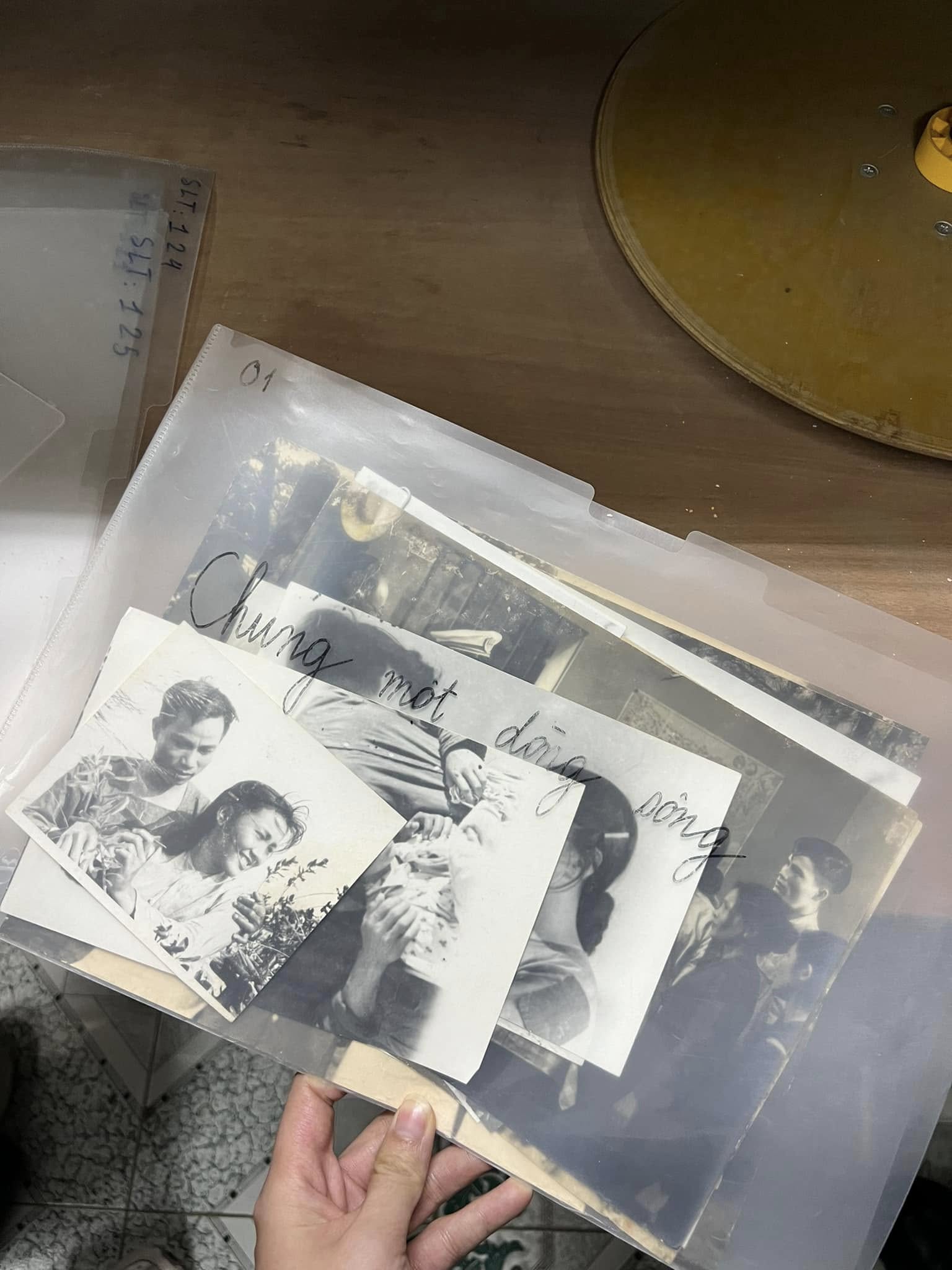
Archive reports of Chung Một Dòng Sông- the first film created by the Vietnamese Revolution Cinema Industry.
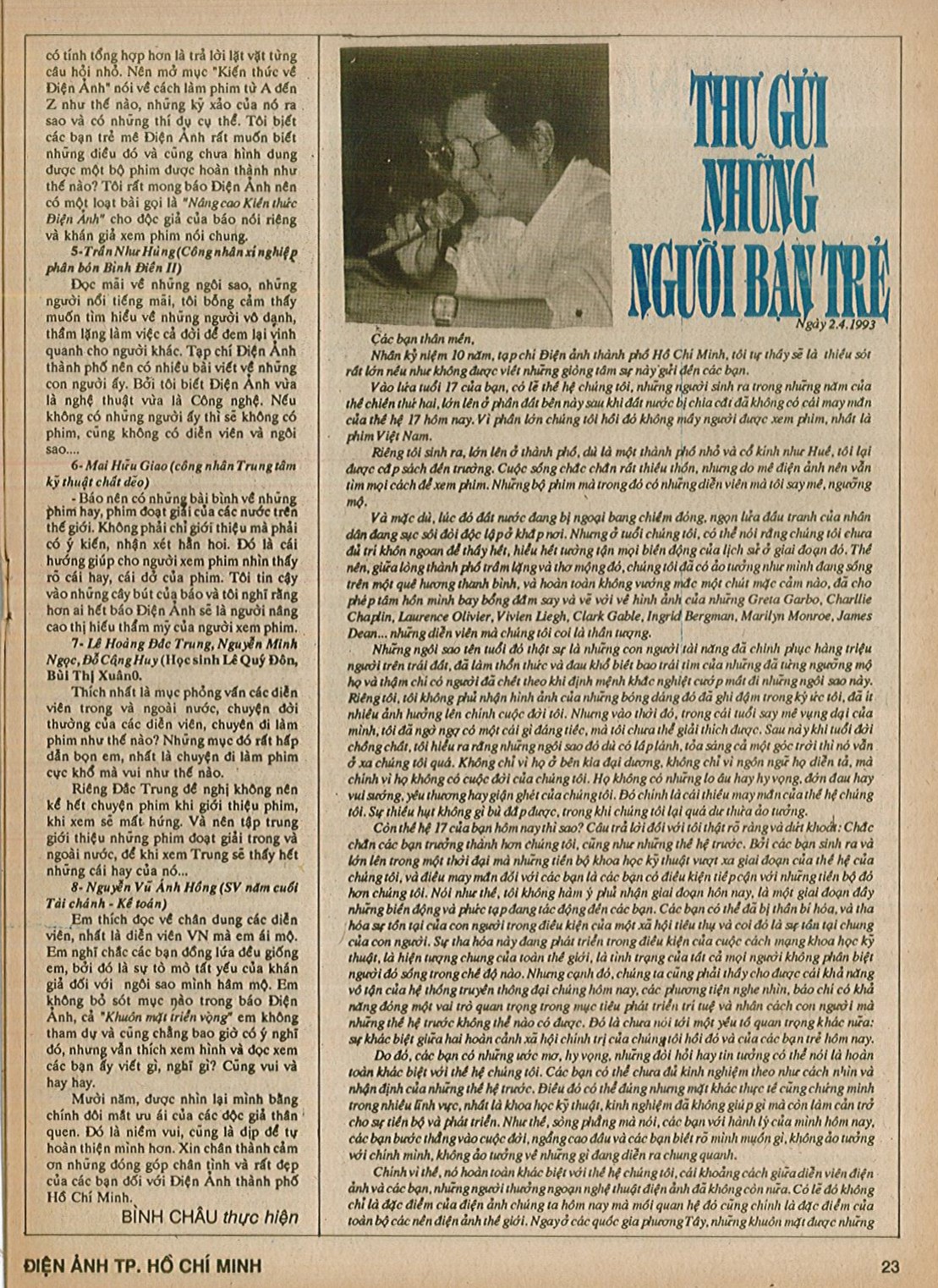
A letter from 1993 to future cinephiles, recovered from a long-lost Vietnamese newspaper.
Eunice: How do you approach programming in a context where certain films may be restricted or censored? Does this limitation shape the structure of your program?
An: While it’s true that Vietnam’s environment is tricky in certain regards for practitioners, often more “bureaucratic” than necessarily “restrictive”, it is not a passive condition we’re simply locked in; Much of Vietnam’s independent film activities have been able to operate under “unspoken” terms. There’s a kind of mutual understanding that even the curators themselves don’t have complete freedom to grant freedom to others, as many factors controlled by the institutions shape the framework we operate in. The strategy, therefore, becomes an exercise in negotiation in which, for a project to be possible at all, there must be a shared agreement among curators, artists, and audiences for the conversations to take place within a dense set of rules. Again, to borrow another Viet curator’s word here (artist Vũ Đức Toàn in reference to the Skylines 4 Project): “Almost as a way of consoling ourselves, we tell each other that perhaps we are all playing this strange game, and that we will get through it together.”
I think that over time, this has become a default mode of thinking for me, a kind of coping mechanism embedded within one’s practice, and as I often joke, coping mechanisms are the familiar mechanisms. Similarly, nostalgia for lost spaces has become a constant presence within us. I imagine the program as a space shaped like a campfire gathering. There is something akin to telling ghost stories: narratives of places and images that linger, even as they vanish. It isn’t really a response to censorship, but rather a reflection of how such conditions have been internalized, and so how those sets of rules would influence the program’s structure in ways that are less about reacting to restriction and more about inhabiting the mental residues it leaves behind.
Eunice: You’re considering whether to expand beyond Vietnamese cinema or situate it alongside other regional works. What possibilities—or tensions—do you see in that decision?
An: Within our own regional social development, I do believe there are parallels in social conditions, not only within Vietnamese cinema, but also in how it resonates with other Asia-Pacific works. It’s also part of my ethos to keep an open-ended approach to the programme, so there’ll be room for unexpected possibilities and encounters to emerge.
But there’s a multitude of layers to consider, not only in terms of social histories, but also filmic histories, especially when we look at specific forms like short films, which have developed along their own trajectories. One of the key tensions, I expect, will be in the variation of film language and expression across filmmakers at different levels of practice and production contexts, especially with how they might relate to the subject at hand. For instance, narrative short films tend to be a space for younger practitioners still developing their craft, not entirely fully-formed yet. In Vietnam, this is also shaped by the fact that narrative shorts have only become widespread in the past twenty years, despite an eighty-year film history. That variation can create a kind of dissonance when trying to build a programme that still feels cohesive in terms of craft and artistic perspective.
Eunice: Your process seems deeply tied to research and accumulation—notes, archives, fragments. How do you begin shaping this material into a program?
An: By fate, haha. I find myself drawn to images of places that have become deeply familiar, yet are marked by their disappearance. Their loss often feels prefigured by their marginalization, as if their erasure was already inscribed within their existence in the given moment. And so the act of recalling them turns into a kind of myth-making.
Realistically, there’s always too much that can’t be shared, especially in a 10-film program. Restraint becomes a rule of practice; everything has to fold back into the films themselves. I think of the films as a kind of central nucleus, where everything else circles them, and so you always begin with the films (or the images), and then with their inscriptions. There will be doors unlocked, of course. I hope the program can evoke a kind of pull within the audience. But those doors aren’t meant to be fully open here, just unlocked. The life of the films extends beyond the program, so those notes, archives, and fragments continue outward, beyond what can be contained within it.
Eunice: In a context where histories can feel incomplete or erased, what role do you think curation can play?
An: Curating is, for me, in a more personal and conceptual sense, a way of thinking of time, of life and death, and of things that have passed. Screening archival films is in itself an effort to reach toward things that are no longer there, a certain weight, a sense of what’s been lost that we are trying to harken back.
As much as my admittedly angsty 24-year-old self likes to fixate on ideas of “the void,” to incompletion and erasure as a kind of darkness, being a programmer, or even just someone who believes in cinema, you have to hold onto the belief that life after nothingness is possible. Cinema, after all, is about light.
Trần Khánh An is a film writer and programmer based in Vietnam, active in many local Southeast cinematic communities while working at the intersection of past and present film movements through criticism, archival research, and curatorial practices.
As a programmer, curator, and distributor, he supporst emerging local talents by creating space and context for their work within limited environments, while connecting past and present Vietnamese film histories and studies as a living continuum. At the core of his practice is a hopeful belief in cinema’s power to reunite, uplift, and sustain communities.
About the Cinemata Community Curators Residency
The Cinemata Community Curators Residency supports curators across the Asia-Pacific to develop film programmes, playlists, and public screenings on Cinemata. It is part of a broader effort to build a community-driven platform where films remain accessible, contextualized, and in dialogue with the issues they engage.
In partnership with Elevated Frames, as part of their residency, the curators will be guided by Eunice Helera, Programme Coordinator, who will be working closely with them through conversations, questions, and ongoing exchanges. Together, they will navigate not only what these programmes become, but how they are formed.