Cinemata cited in UN Special Rapporteur's final report on freedom of expression
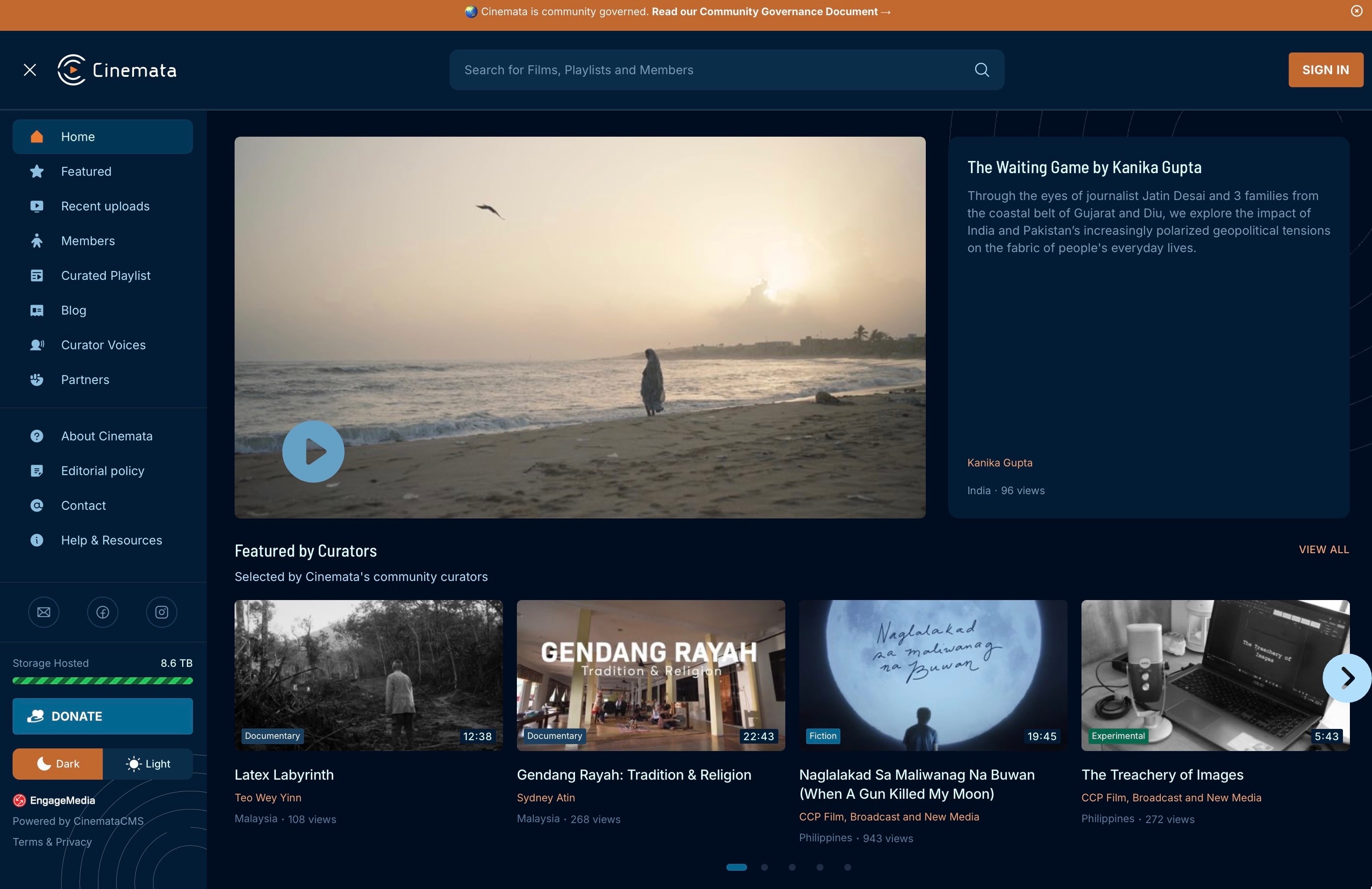
In her final report to the United Nations Human Rights Council, Special Rapporteur Irene Khan named Cinemata as an example of the kind of platform the world needs more of.
The report, submitted in June 2026, is an urgent assessment of what Khan calls "a crisis of expression" — one created not just by authoritarian governments, but by a small group of tech oligarchs who have privatised and monetised the global information environment without accountability to anyone.
Khan spent six years as the first woman to hold the Special Rapporteur mandate on freedom of opinion and expression. Her tenure produced some of the most direct formal challenges to platform power in the history of the role — on disinformation, on the weaponisation of national security laws against journalists, on the decline of independent media, and on AI systems that manipulate information at scale with no human rights guardrails. She built her findings through in-country consultations with civil society and journalists across multiple regions, including the Philippines in 2024.
Her final report brings those threads together. It documents how platforms have rolled back content protections, how AI-generated summaries are draining revenue from independent journalism, and how states and platforms are increasingly working in tandem to narrow the space for free expression. The costs, she writes, are borne not by those who profit, but by journalists, human rights defenders, and the public.
The last section of the report, "Resist, Reform, Reclaim," turns to what she calls "green shoots." It is here that Cinemata appears.
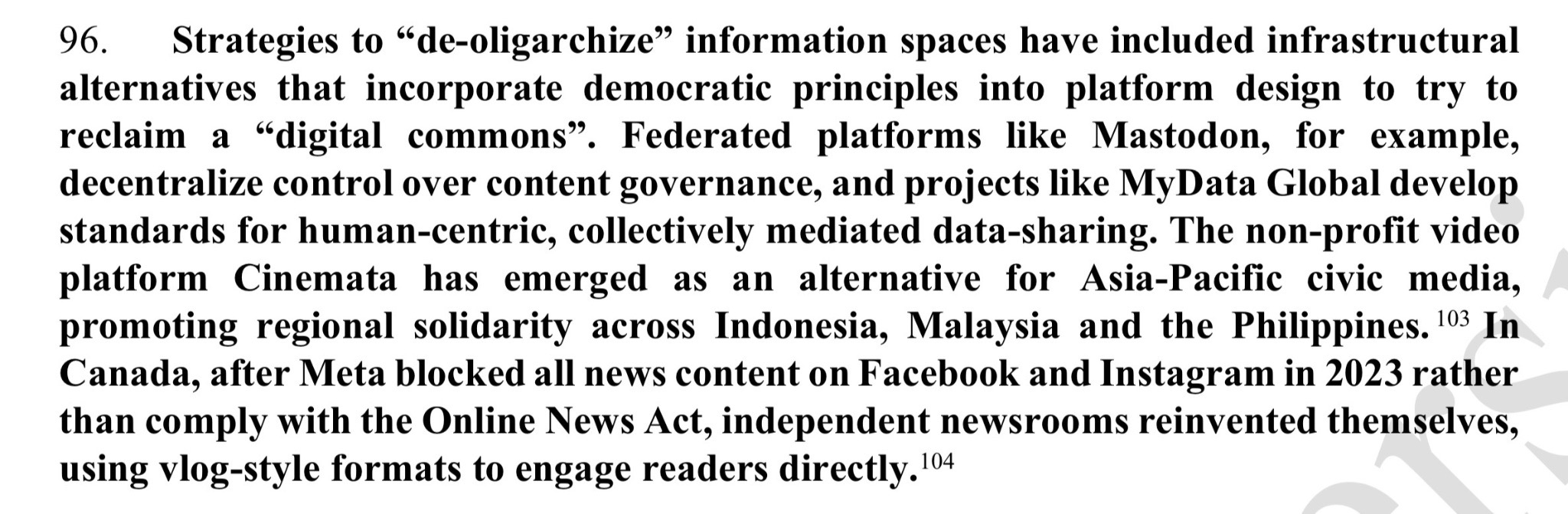
Paragraph 96 of UN Special Rapporteur Irene Khan's final report to the Human Rights Council (A/HRC/62/67, June 2026), naming Cinemata alongside Mastodon and MyData Global as examples of platforms working to "de-oligarchize" information spaces.
Cinemata is a free, ad-free video platform hosting more than 7,200+ social issue films from across Asia-Pacific. It carries no advertising. It does not sell filmmaker or audience data. Its curation is done by human curators, not algorithms. It runs on CinemataCMS, an open-source platform developed independently by a Southeast Asian team, hosted outside hyperscaler infrastructure.
This recognition affirms the importance of sustaining independent, rights-respecting platforms that protect civic expression, cultural memory, and community-led media circulation. As online spaces become increasingly shaped by commercial extraction, censorship, and algorithmic control, platforms like Cinemata offer a different model: open-source, privacy-first, human-curated, and accountable to the communities they serve.
On June 10, 2026, the Cinemata community adopted a Community Governance Document during its First Community Convening that sets out how decisions are made, who holds accountability, and what values guide the platform. It is what democratic platform design looks like in practice.
For media organisations producing short documentaries and news reports, Cinemata offers a distribution home that does not extract value from the work it hosts. If you are interested in hosting a collection or exploring a partnership, we would like to hear from you.
For organisations that want to build independent video infrastructure on their own terms, CinemataCMS is open-source. Learn more here.
Cinemata’s next chapter is focused on strengthening this work: putting community governance into practice, sustaining open-source development, expanding regional curation, and building tools for impact distribution. We welcome conversations with partners who share this commitment to building more democratic, rights-respecting spaces for media and civic expression.
The crisis Khan describes is structural. So are the alternatives. Cinemata is one of them.
Cinemata is developed and managed by EngageMedia, a nonprofit that promotes digital rights, open and secure technology, and video for change.