Cinemata Community Governance Document 1.0.0
Version 1.0 - 11 June 2026
Preamble
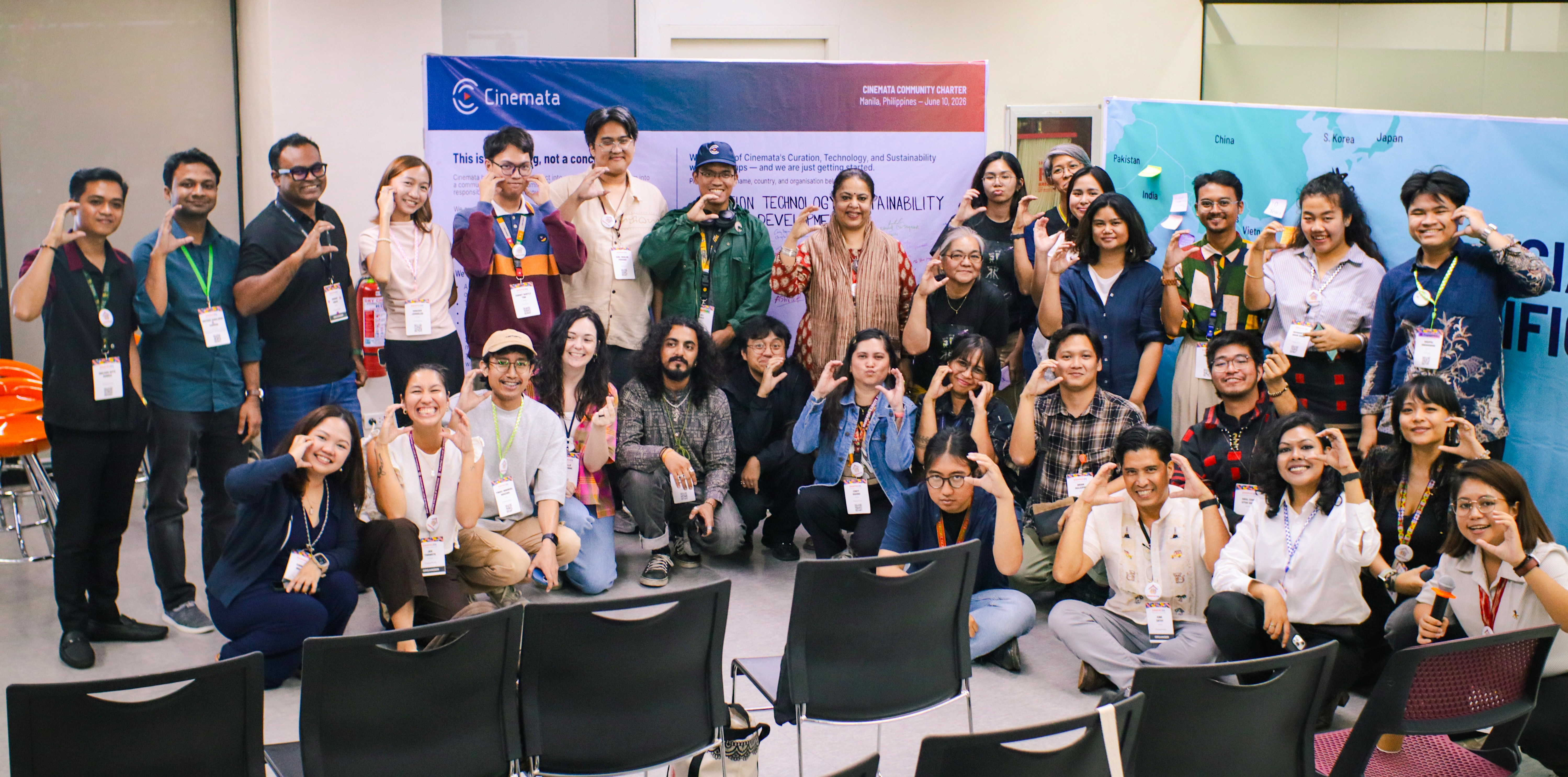
This document is an opening, not a conclusion.
Cinemata has grown from a project into a platform, from a platform into a community, and from a community into something that now carries responsibilities larger than any single team or funding cycle can hold alone. That growth calls for a different kind of thinking about how Cinemata is governed, sustained, and shared.
This governance document is the beginning of that thinking made visible. It does not declare a finished structure. It does not transfer power or dissolve existing relationships. What it does is name what Cinemata has become, articulate the values that should guide its future, and begin to describe, honestly and carefully, how the community that has built it can have a genuine stake in where it goes.
It is written for everyone who has a relationship with Cinemata: filmmakers who trust it with their work, curators who shape its voice, developers who build and maintain its infrastructure, partners who bring it into their communities, and the broader network of people across the Asia-Pacific who believe that independent, community-controlled media infrastructure matters.
It will be revised. It will be questioned. It should be. That is the point.
1. On the Concept of the Rhizome
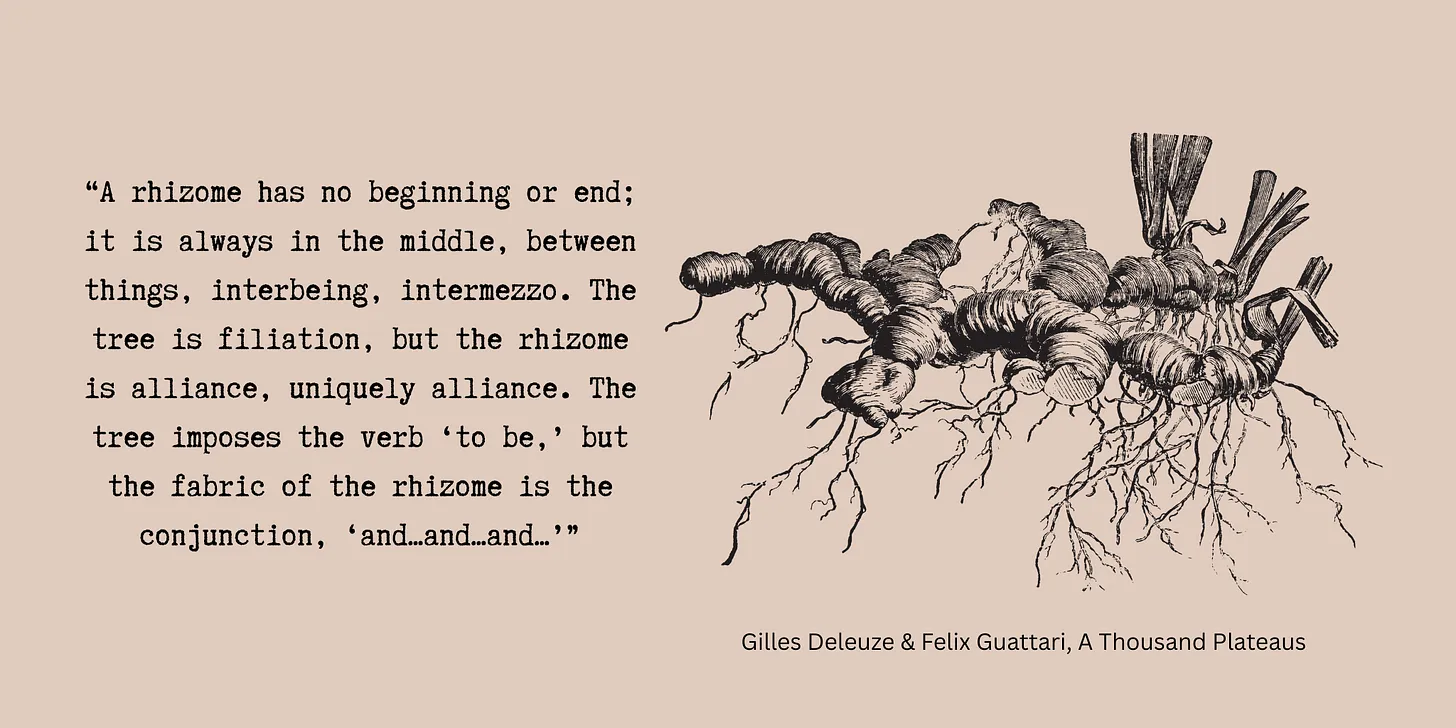
Image from Rhizome has no beginning or end
The rhizome is a concept borrowed from the philosophy of Gilles Deleuze and Félix Guattari, introduced in their 1980 work A Thousand Plateaus. Drawing from botany — where a rhizome is a root system that spreads horizontally with no central trunk, no fixed beginning or end — they used it to describe systems of thought, culture, and organisation that resist hierarchy and centralisation. Unlike a tree, which grows from a single root and branches outward in fixed directions, a rhizome can be entered from any point, broken and reconnected, and extended in unexpected directions. It became an influential framework in cultural theory, social movements, and, more recently, in thinking about decentralised networks and open-source communities.
2. Cinemata as a Single Rhizome with Two Expressions
Cinemata is a single rhizome with two expressions. CinemataCMS is its expression in code — open-source, deployable anywhere, owned by no single entity, capable of seeding entirely new communities wherever it is planted. Cinemata.org is its expression in community — a regional network of filmmakers, curators, educators, and human rights defenders connected horizontally across the Asia-Pacific, with no single country or institution defining whose stories matter most. Neither expression is meaningful without the other: the code without a community is just a repository; the community without the open-source codebase is just another closed platform. Together they become something that cannot be easily owned, captured, or shut down — and that is not incidental to Cinemata's design. It reflects a deliberate commitment to decentralised, community-driven infrastructure that mirrors the values of the movements it serves.
3. Toward Rhizomatic Governance: Direction and the Role of the Steering Committee
If Cinemata is rhizomatic by design, then its governance cannot be a tree. A top-down charter handed down from a single institution would contradict the very nature of what Cinemata is and who it serves. The governance direction being developed here is built around shared stewardship, values as guardrails, and a distribution of roles that keeps operations grounded while opening direction-setting to a broader community. It is not a finished model — it is a direction, being worked out in the open.
The Cinemata Steering Committee is the first formal expression of this direction. Convened as a voluntary, non-operational advisory body, it exists to orient rather than manage — to bring strategic perspective, regional insight, and values-based sense-checking to the questions Cinemata faces as it grows. The Hanoi meeting is where this work begins: not as a handover of a finished framework, but as a space to build shared understanding and shape the first cycle together. What follows in this document is the thinking we are bringing to that conversation.
4. Who We Are
Cinemata began as a project of EngageMedia, a nonprofit that has been building open-source video platforms for advocacy communities since 2006. It launched in 2021 with a specific purpose: to fill a real, widening gap. Most socially engaged short films in the Asia-Pacific have a brief life as festival entries or classroom projects, then largely disappear. They lack independent, long-term infrastructure for hosting, discovery, and sustained dialogue. Meanwhile, the broader environment was not getting easier — mainstream platforms prioritise algorithms, monetisation, and advertising over access and impact, and censorship and repression of arts and media were intensifying across the region. Cinemata was built as a counterpoint: a space specifically for social issue films, grounded in editorial care, community context, and a commitment to maintaining access where other platforms may be unreliable or unsafe.
Today, Cinemata hosts over 7,200+ films from more than 30 countries, spanning issues of climate change, conflict, freedom of expression, gender and sexuality, food security, labour rights, migration, and civic space. But it has grown into something larger than a hosting platform. It is an ecosystem of filmmakers uploading and sharing work, community curators creating thematic playlists and providing regional context, educators using films in classrooms and advocacy campaigns, and festival and cultural partners extending their programmes beyond physical venues. The platform is used not just by those who make films, but by the broader range of people who activate them: programmers, organisers, and educators who bring films into the communities where they matter most.
Cinemata is also increasingly a piece of regional infrastructure. CinemataCMS — the open-source content management system that powers Cinemata.org — is developed by a regional team of Southeast Asian developers and is publicly available for any organisation to deploy. This means the technology that hosts some of the most sensitive advocacy work in the region is community-controlled, transparent, and replicable. No single company can take it down, change its terms, or monetise its users. This is not incidental to what Cinemata is — it is central to it. The platform and the codebase together constitute a deliberate expression of the values that brought Cinemata into being.
This governance document emerges from that growth. As Cinemata has expanded from a project into a regional community with its own identity, relationships, and responsibilities, it has become important to begin articulating — together — what that community is, how it makes decisions, and what it stands for.
5. Core Principles
Cinemata's governance is not built on neutral ground. The platform exists because mainstream infrastructure failed social-issue filmmakers through algorithmic marginalisation, commercial pressure, state censorship, and surveillance. The principles below are not aspirational statements. They are the boundaries within which all governance decisions, sustainability pathways, partnerships, and technical directions are made.
Community-governed and regionally grounded
Cinemata's direction is shaped by the communities it serves — filmmakers, curators, educators, and advocates across the Asia-Pacific — not by funders, algorithms, or institutional convenience. Regional equity is not an afterthought; it is a design principle. Decisions should reflect the diversity of contexts, languages, and power relations across the region.
Feminist and inclusive technology
Care, accessibility, safety, and equity are built into how the platform is developed and governed. This means centring the needs of those most at risk — women filmmakers, LGBTQ+ communities, activists operating under repression — and ensuring that governance structures do not reproduce the exclusions they seek to resist.
Privacy by design, not compliance
For many of the people Cinemata serves, exposure is not an abstract risk. Privacy is therefore a foundational technical and editorial commitment, not a checkbox. Features, partnerships, and infrastructure choices are evaluated against this standard.
Openness and collective ownership
The codebase is open-source. The platform is ad-free. User data is not monetised. These are not features — they are expressions of a commitment to collective ownership over the technology and community that Cinemata has become.
Non-extractive and values-aligned sustainability
Cinemata's survival cannot come at the cost of the communities it serves. Revenue models, institutional partnerships, and funding pathways are assessed against whether they serve community needs and mission, or extract from them.
Transparency and accountability
Decisions are made clearly, with reasoning that can be understood and questioned by the community. Accountability runs not just upward to funders and institutions, but outward to the filmmakers, curators, and partners who make Cinemata what it is.
6. Governance Structure
Cinemata's governance is not a finished model. It is something being built — openly, iteratively, and in consultation with the communities it is meant to serve. What follows describes where things stand now and the direction they are heading.
6.1 EngageMedia: Operational Stewardship
EngageMedia remains Cinemata's operational home. Day-to-day decisions — on technology, moderation, programming, partnerships, and staffing — are made by the Cinemata team within EngageMedia's organisational framework. This includes responsibility for the platform's editorial integrity, security, and financial management. EngageMedia's stewardship is not a transitional arrangement to be dissolved, but a foundation on which broader shared governance is being built.
6.2 The Cinemata Steering Committee: Strategic Orientation
The Steering Committee is the first formal expression of shared governance — a voluntary, non-operational advisory body whose purpose is to orient rather than manage. It does not execute work, make decisions on behalf of Cinemata, or assume legal or fiduciary responsibility. What it does is bring strategic perspective, regional insight, and values-based sense-checking to the questions Cinemata faces as it grows.
In its current pilot phase, the Steering Committee focuses on three things:
- Helping test and refine a governance model that fits Cinemata's mission and regional context
- Stress-testing sustainability assumptions and fundraising pathways
- Clarifying what shared stewardship should look like in practice, beyond this initial group
Membership is drawn from across the Asia-Pacific, with deliberate attention to regional equity, lived experience of civic space pressures, and alignment with Cinemata's core principles. The composition of future iterations of the Steering Committee — and the process by which members are invited or elected — will be refined through the governance co-design process currently underway.
6.3 The Broader Community Layer
Beyond EngageMedia and the Steering Committee, Cinemata's governance draws on a wider ecosystem of participants whose voices and contributions shape the platform's direction. This includes:
-
- Community Curators — who bring regional context, editorial judgment, and direct relationships with filmmakers and advocacy communities
- Developers — who contribute to CinemataCMS as an open-source project, and whose technical decisions carry governance implications
- Partner organisations — festivals, universities, collectives, and advocacy groups whose ongoing collaboration shapes how the platform is used and what it needs to become
- Filmmakers and users — whose needs, safety concerns, and creative practices are the platform's ultimate reference point
This layer does not yet have formal governance mechanisms. Part of what the current governance process is working toward is finding appropriate, lightweight ways to bring these voices into decision-making — without creating structures so heavy they become inaccessible.
6.4 Decision-Making
At this stage, decision-making authority remains with EngageMedia and the Cinemata team. The Steering Committee's role is advisory. What is being developed, through this document and the co-design process it initiates, is a clearer framework for which kinds of decisions benefit from broader input, how that input is gathered, and how the community is informed of outcomes. This framework will be refined over time, with changes reflected in future versions of this document.
7. Working Groups
Working groups are how the broader community layer described in Section 6 begins to take on a more defined role in shaping Cinemata's direction. They are not operational units — they do not manage staff, hold budgets, or make binding decisions. They are spaces where people with relevant expertise and commitment can think together, surface issues, and feed recommendations into the Steering Committee and Cinemata team.
Three working groups are envisioned for the current phase. None is fully formed yet. Their establishment will be part of the governance co-design process initiated at Hanoi and developed through the Steering Committee's first cycle.
7.1 Tech Working Group
The Tech Working Group brings together developers, security researchers, and technically oriented community members to provide input on CinemataCMS's development direction. This includes reviewing technical priorities, surfacing privacy and security concerns, and contributing to the open-source codebase in ways coordinated with the core development team.
Because CinemataCMS is publicly available and deployable by other organisations, the Tech Working Group also carries a broader responsibility: ensuring that development decisions serve not just Cinemata.org but the wider ecosystem of organisations that may build on the platform. This is governance in the rhizomatic sense — decisions made here extend beyond any single deployment.
7.2 Curation Working Group
The Curation Working Group brings together Cinemata's community curators, partner organisations, and editorial allies to collectively develop and maintain the curatorial standards, regional priorities, and editorial practices that shape what Cinemata presents and how. This includes input on the editorial policy, thematic programming directions, and how the platform navigates sensitive content in different regional contexts.
Curation is not neutral. In a region where censorship is intensifying, and at-risk communities depend on trusted platforms, curatorial decisions are also safety decisions. The Curation Working Group is the space where those decisions are thought through collectively, with the people who understand the regional stakes most directly.
7.3 Sustainability Working Group
The Sustainability Working Group supports the Steering Committee's focus on long-term financial and organisational resilience. It explores and evaluates revenue models, partnership structures, and funding pathways — always through the lens of the core principles established in Section 5. It does not pursue funding on Cinemata's behalf, but helps develop the thinking and frameworks that inform those decisions.
This group is particularly important given the current funding environment. As global civil society funding contracts and the landscape for progressive tech grow more precarious, having a dedicated space to think carefully and collectively about sustainability without compromising mission is no longer optional. It is foundational.
7.4 How Working Groups Form and Operate
Working groups are convened by the Cinemata team in consultation with the Steering Committee. Membership is open to community members whose expertise and values align with the group's mandate. Each working group determines its own rhythm and ways of working, with light documentation of discussions and recommendations shared back to the Steering Committee and Cinemata team.
Working groups may be dissolved, merged, or reconstituted as Cinemata's needs evolve. New working groups may be proposed by any community member and established by mutual agreement between the Steering Committee and Cinemata team.
8. Community Participation
Cinemata's community is not a user base. It is the reason the platform exists — and, increasingly, the source of its legitimacy, editorial judgment, and sense of direction. Governance that fails to bring that community into decision-making in meaningful ways is governance in name only.
At the same time, participation cannot be performative or extractive. Asking filmmakers, curators, and partners to contribute their time and knowledge to governance processes without clear channels, genuine influence, or appropriate recognition reproduces the same dynamics Cinemata exists to resist. Community participation has to be real, accessible, and worth showing up for.
8.1 Current Forms of Participation
Community participation in Cinemata already exists in practice, even where formal governance structures are lacking. Curators shape what the platform foregrounds and how. Developers contribute to CinemataCMS and influence its technical direction. Partner organisations bring institutional knowledge and community relationships that inform programming decisions. Filmmakers, through their uploads, their feedback, and their ongoing presence on the platform, continuously signal what Cinemata is and what it needs to become.
This document begins the process of making those informal contributions more legible — and more consequential.
8.2 The Community Convening
Cinemata holds periodic community convenings — gatherings of filmmakers, curators, developers, partners, and allies that serve as the primary space for open dialogue about the platform's direction. These are not conferences or product launches. They are working spaces where the community comes together to reflect, question, and collectively shape what Cinemata is becoming.
The convening is also the space where governance documents and major shifts in direction are presented to the community for input and, where appropriate, ratification. No governance change that significantly affects the community's relationship to the platform should be adopted without first being brought to a convening for discussion.
The frequency, format, and scope of convenings will evolve as the community grows. What remains constant is the principle: the community has a right to be informed, consulted, and heard before major decisions are made.
8.3 Pathways for Community Input
Between convenings, community members can contribute to governance through several channels:
-
- Working groups — as described in Section 7, open to community members with relevant expertise and commitment
- Curatorial and editorial feedback — through direct engagement with the Curation Working Group and Cinemata's editorial team
- Open-source contribution — through CinemataCMS's public GitHub repository, where technical decisions are documented and open to community review
- Direct communication — with the Cinemata team and Steering Committee, through channels that are clearly published and consistently monitored
These pathways are not yet uniformly formalised. Part of the work ahead is developing clearer, more accessible entry points for community members who want to engage with governance but do not know where to start.
8.4 Ratification and Community Consent
Certain decisions require more than consultation — they require community consent. These include significant changes to the editorial policy, terms of service, or privacy approach; major shifts in the platform's sustainability model; and revisions to this governance document itself.
The ratification process is still being developed. What is established here is the principle: the community's consent matters, and governance structures that bypass it — even for pragmatic reasons — undermine the legitimacy of everything built on top of them.
This is what it means to be serious about community-governed infrastructure. Not that every decision is made by committee, but that the community has genuine power over the decisions that most affect it.
9. Sustainability and Revenue Ethics
Sustainability is not a financial problem with a financial solution. It is a value question. How Cinemata sustains itself over time will determine, as much as any editorial policy or governance structure, what kind of platform it remains and who it continues to serve. This section does not present a business plan. It establishes the ethical framework within which sustainability decisions are made.
9.1 The Current Context
Cinemata was built on grant funding, and that funding has made everything described in this document possible. It has also made Cinemata vulnerable to the rhythms and priorities of institutional funders — and those rhythms are shifting. Global civil society funding is contracting. The geopolitical environment is increasingly unstable. Organisations like EngageMedia, operating at the intersection of digital rights, free expression, and social-issue media, are working in a funding landscape more precarious than it has been in years.
This is not a reason for alarm. It is a reason for honesty — and for building a governance model that takes sustainability seriously, not as an afterthought but as a core responsibility of the community that Cinemata serves and represents.
9.2 What We Will Not Do
Before exploring what is possible, it is worth being clear about what is not. The core principles established in Section 5 function as hard limits on how Cinemata can pursue sustainability. Specifically:
-
- Cinemata will not monetise user attention, sell user data, or introduce advertising
- Cinemata will not pursue funding or partnerships that require compromising editorial independence or platform openness
- Cinemata will not introduce pricing models that price out the communities — activists, emerging filmmakers, grassroots organisations — that the platform was built to serve
- Cinemata will not adopt revenue models that create extractive relationships with the filmmakers whose work gives the platform its value and legitimacy
These are not negotiable. Any sustainability pathway that requires crossing these lines is not a pathway Cinemata will take, regardless of the financial pressure involved.
9.3 Pathways We Are Exploring
Within those limits, there is meaningful space to build sustainable revenue. The Sustainability Working Group and Steering Committee are currently exploring several directions, none of which are final commitments:
-
- CinemataCMS professional services — managed hosting, implementation support, and custom development for organisations deploying the open-source platform. This generates revenue from the codebase's value without restricting access to it.
- Institutional partnerships — with universities, film schools, cultural institutions, and advocacy organizations that use Cinemata's archive and programming infrastructure in their work, and for whom a formal partnership has clear value.
- Community-supported models — membership or contribution frameworks that invite individuals and organizations who benefit from the platform to support it financially, on terms that are transparent and voluntary.
- Earned income through services — training, curation support, screening facilitation, and capacity-building for organizations working in aligned spaces.
- Diversified grant funding — reducing dependency on any single funder by broadening the range of institutional, foundation, and thematic funding relationships.
Each of these will be evaluated against the values framework in Section 5 before being adopted. The Steering Committee's role is to help stress-test these pathways — not to pursue them operationally, but to bring the kind of strategic and regional perspective that helps Cinemata make good decisions about which directions are worth pursuing and which carry risks that are not immediately obvious.
9.4 The Relationship Between Sustainability and Community
Ultimately, Cinemata's most durable form of sustainability is not financial — it is relational. A platform that is genuinely valued by its community, that has built trust with filmmakers and partners over the years, and that is embedded in regional networks of advocacy and practice is harder to displace than one that is merely well-funded. Revenue models matter, but they work best when they are expressions of relationships that already exist, rather than substitutes for them.
This is why the governance work described in this document is inseparable from the sustainability work. A community that has a genuine stake in the platform — that participates in its governance, shapes its direction, and understands its values will show up for it when it matters most.
10. Amendments and Evolution
This document is not finished. It is the first written expression of a governance process that is still being built — and it should remain open to revision as that process matures, as the community grows, and as circumstances change in ways none of us can fully anticipate.
A governance document that cannot be amended is a tree pretending to be a rhizome. The ability to revise, question, and collectively reshape this framework is not a weakness in the model — it is proof that the model is working.
10.1 Principles for Amendment
Any revision to this document should be guided by the same values that shaped it. Amendments should:
-
- Emerge from genuine community dialogue, not unilateral decisions by any single person or institution
- Be transparent in their intent — changes should be clearly explained, with reasoning that the community can understand and question
- Be proportionate — minor clarifications do not require the same process as changes to core principles or governance structures
- Strengthen rather than erode community participation and accountability over time
10.2 The Amendment Process
In the current phase, proposed amendments to this document are initiated by the Cinemata team or Steering Committee, shared with the broader community for input, and presented at a community convening for discussion before being adopted. No amendment to Sections 1–5, the foundational framing and core principles, should be adopted without community consultation.
As governance structures mature and working groups become more established, the amendment process itself will evolve. The expectation is that, over time, the community will have more direct pathways to propose and ratify changes — moving gradually from a model in which the Cinemata team initiates revisions toward one in which the community holds that power collectively.
10.3 Versioning
Each adopted version of this document carries a version number and date. Previous versions are archived and publicly accessible. The history of how this document has changed is itself a record of how Cinemata's governance has evolved, and that record belongs to the community.
10.4 A Living Document
The rhizome does not stop growing. Neither should this framework. What matters is not that we get everything right in this first version, but that we have built a process for getting closer to right over time — together, openly, and in ways that remain accountable to the communities Cinemata exists to serve.